

Blogs
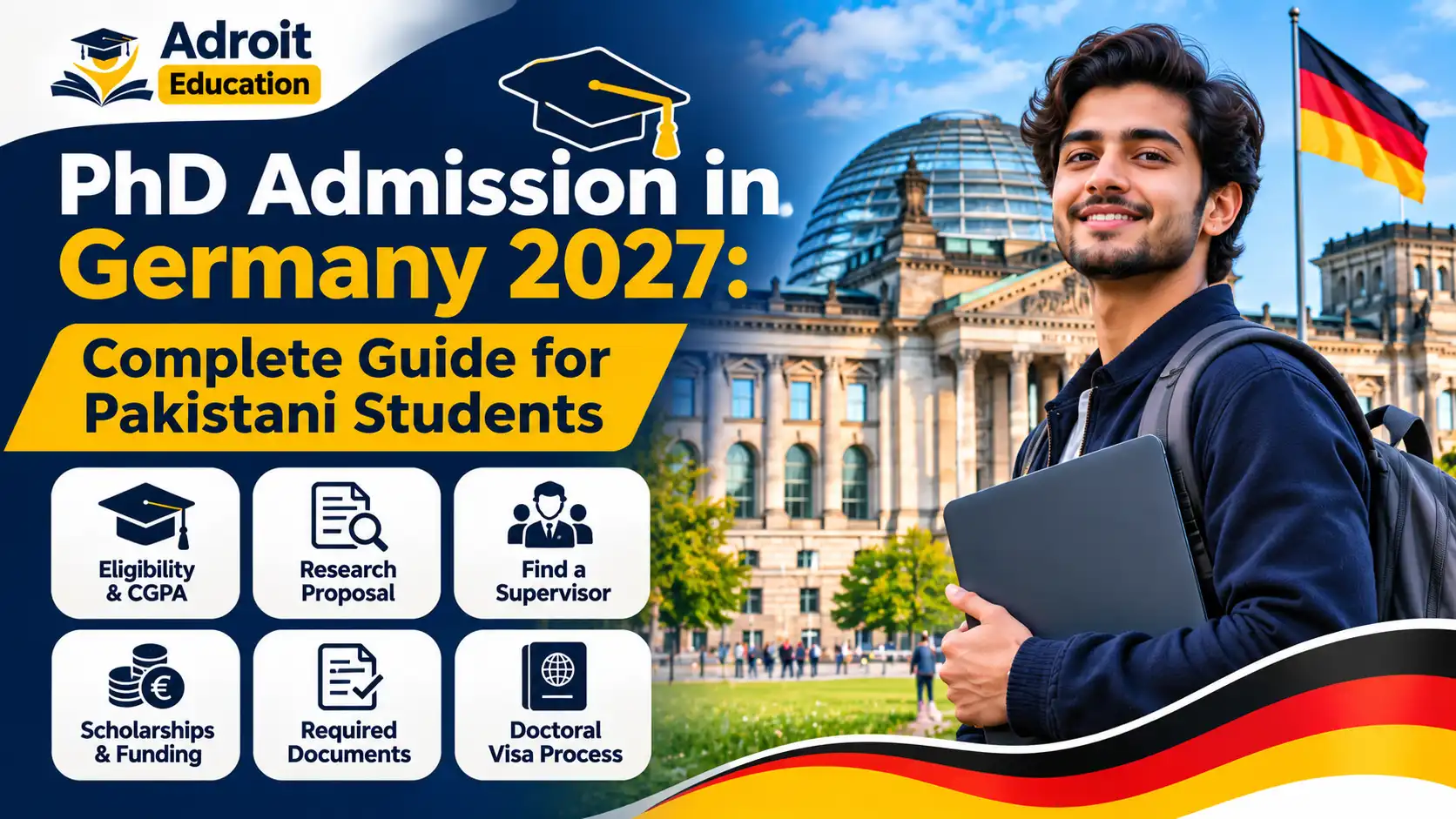
PhD Admission in Germany 2027: Complete Guide for Pakistani Students

Introduction
PhD Admission in Germany for Pakistani Students 2027: Complete Guide
Germany is an established destination for international doctoral researchers because of its universities, research institutions, laboratories and industry-linked research projects. Pakistani graduates interested in advanced academic research can explore doctoral opportunities in engineering, medicine, life sciences, computer science, business, natural sciences and social sciences.
PhD Admission in Germany can be pursued through different doctoral routes, including individual doctorates supervised by a professor and structured doctoral programmes. The appropriate route depends on the applicant’s academic background, research interests, subject area and the admission regulations of the institution.
Unlike a taught Master’s degree, a doctorate is centred on independent research and an original academic contribution. Applicants should therefore prepare a clear research direction, relevant academic documents and evidence of their ability to undertake advanced research.
This guide explains the main requirements and application process for Pakistani students planning to pursue a PhD in Germany for the 2027 intake. A clear academic plan is an important starting point for doctoral study applications.
1. Why Choose Germany for Doctoral Research?
Germany has a strong academic and research environment, supported by universities, research organisations and specialist institutes.
1.1 Established Research Institutions
Doctoral researchers may find opportunities in engineering, biotechnology, healthcare, artificial intelligence, physics, chemistry, environmental sciences and other disciplines. For doctoral study applications, applicants should compare the research strengths of each institution.
Research groups may collaborate with industry, public institutions and international academic partners.
1.2 Individual and Structured Doctoral Routes
Germany offers more than one way to pursue doctoral studies. Applicants may work under an individual supervisor or apply to a structured doctoral programme.
The best route depends on the subject, research topic, funding arrangement and the university’s doctoral regulations. The right research environment can make doctoral study applications a better match for your academic goals.
1.3 English-Language Research Opportunities
Many doctoral projects and research groups use English as their working language. However, language requirements differ between institutions and positions.
German may not be compulsory for every research project, but it can be valuable for daily life, collaboration and future employment. Applicants should assess supervisor fit carefully when planning doctoral study applications.
1.4 Research Funding and Career Development
Doctoral candidates may explore scholarships, funded research positions and project-based opportunities. Funding conditions vary, and applicants should distinguish between a scholarship, an employment contract and an unfunded doctoral admission.
2. PhD Admission in Germany: Academic Eligibility
Applicants generally need a recognised Master’s degree or an equivalent qualification that meets the doctoral regulations of the relevant university.
2.1 Master’s Degree Requirement for PhD Admission in Germany
A completed Master’s degree in a relevant subject is the usual academic route to doctoral admission. A relevant Master’s background helps universities evaluate PhD Admission in Germany applications.
The university or doctoral committee assesses whether the previous qualification provides sufficient academic preparation for the intended research area.
Some exceptional routes may be available to particularly qualified Bachelor’s graduates, but these depend on specific institutional and subject rules.
2.2 CGPA and Academic Performance for PhD Admission in Germany
A CGPA of 3.0 or above can be a useful preliminary academic benchmark for profile assessment. However, it is not a universal admission requirement for every German doctoral programme. The complete academic record matters when preparing for PhD Admission in Germany.
Universities may consider the applicant’s overall academic record, Master’s thesis, research experience, publications, subject knowledge and fit with the proposed research project.
2.3 Relevant Research Background
Applicants should demonstrate a connection between their previous education and intended research area. Research experience can help demonstrate readiness for PhD Admission in Germany.
Relevant evidence may include:
- Master’s thesis or dissertation.
- Research projects.
- Laboratory or fieldwork experience.
- Academic publications, if available.
- Conference presentations.
- Research assistant experience.
- Specialist training or relevant professional work.
Publications can strengthen an application, but they are not compulsory for every PhD position.
3. PhD Admission in Germany: Research Proposal Requirements
A research proposal is particularly important for many individual doctoral applications. It helps a potential supervisor or selection committee understand the research question, academic relevance and proposed methodology. A focused proposal supports a stronger application for PhD Admission in Germany.
A proposal commonly includes:
- Proposed research title.
- Background and research problem.
- Research gap or rationale.
- Research aims and objectives.
- Research questions or hypotheses.
- Preliminary literature review.
- Proposed research methodology.
- Expected academic contribution.
- Research timeline.
- References.
The required length and format vary. Follow the instructions of the university, doctoral programme or potential supervisor rather than using one generic proposal for every application.
3.1 Selecting a Research Topic for PhD Admission in Germany
Choose a topic that connects your previous academic training with a research area supported by the university or research group. The research question should be realistic for the intended PhD Admission in Germany route.
A strong topic should be focused, researchable and realistic within the expected doctoral period. Applicants should also consider access to data, laboratory facilities, equipment, ethical approval and supervision.
3.2 Finding a Supervisor for PhD Admission in Germany
For an individual doctorate, applicants commonly identify professors whose research interests match their proposed topic. Applicants should tailor each proposal to the institution offering PhD Admission in Germany.
Before contacting a supervisor:
- Read their recent research publications.
- Review the university department’s research areas.
- Identify a clear connection between your background and their work.
- Prepare a concise academic CV.
- Develop a focused research summary.
- Follow any instructions on the professor’s official profile.
A personalised and academically relevant email is generally more useful than sending the same generic message to many professors.
4. PhD Admission in Germany: IELTS and Language Requirements
Language requirements depend on the doctoral programme, research group and institution. A supervisor’s research interests should align with your plans for PhD Admission in Germany.
4.1 IELTS Requirements for PhD Admission in Germany
An IELTS score of 6.5 overall, sometimes with minimum band requirements, can be a useful preliminary preparation target. However, German doctoral programmes do not have one universal IELTS requirement.
Some institutions accept TOEFL, previous English-medium education or another form of language evidence. Others require a specific test score. Check each department’s language policy before applying for PhD Admission in Germany.
Always confirm the accepted test and minimum score with the doctoral programme or research institution.
4.2 Can You Apply for a PhD Without IELTS?
Some research groups may accept alternative proof of English proficiency, depending on their regulations. An English-medium education certificate is not automatically accepted by every university.
Obtain confirmation from the institution before relying on an alternative document. Language evidence should match the requirements for PhD Admission in Germany at the selected institution.
4.3 Is German Language Compulsory for a PhD?
Not for every doctoral programme. Many international research projects operate in English.
Pakistani applicants who want to build practical language skills before moving can explore German language courses in Pakistan through Adroit Education.
However, German-language skills can support communication outside the research environment, teaching duties where applicable, professional networking and future employment. German skills can also support daily life while pursuing PhD Admission in Germany.
5. Documents Required for PhD Admission in Germany
Prepare a complete academic and research portfolio. Individual universities and doctoral programmes may request additional documents.
Academic Documents
- Matric certificate and marks sheet.
- Intermediate certificate and marks sheet.
- Bachelor’s degree certificate and transcript.
- Master’s degree certificate and transcript.
- Course descriptions, if requested.
- Master’s thesis or dissertation information, where relevant.
- HEC attestation or other verification, where required.
Personal and Professional Documents
- Valid passport.
- Pakistani CNIC copy.
- Updated academic CV.
- Employment or research experience letters, if applicable.
- Previous passport copies, where available.
Research and Application Documents
- Research proposal, where required.
- IELTS, TOEFL or other accepted language evidence, where required.
- Letter of Motivation.
- Academic recommendation letters.
- Research publications or conference records, if available.
- Writing sample or thesis abstract, if requested.
- Any additional documents required by the university or supervisor.
Not every institution requires every item. Use the official doctoral programme checklist as the final reference. Prepare documents according to the checklist for PhD Admission in Germany.
6. PhD Admission in Germany: Individual vs Structured Doctoral Programmes
Understanding the two common doctoral routes can help applicants select suitable opportunities.
6.1 Individual Doctorate Route for PhD Admission in Germany
In an individual doctorate, the candidate conducts research under the supervision of a professor.
The applicant usually identifies a potential supervisor, develops a research idea and seeks the required academic acceptance. Keep certified academic records ready when arranging PhD Admission in Germany applications.
This route offers flexibility in research planning, but candidates may need to take substantial responsibility for organising their project and progress.
6.2 Structured Programme Route for PhD Admission in Germany
Structured doctoral programmes provide an organised academic environment. Depending on the programme, they may include: Research documents should be consistent across applications for PhD Admission in Germany.
- Research seminars.
- Specialist courses.
- Interdisciplinary training.
- Regular supervision.
- Academic workshops.
- Research collaboration.
- Progress reviews.
These programmes normally have a defined application and selection process. Applicants should check the programme’s entry requirements, funding arrangements and deadlines.
7. PhD Admission in Germany: Scholarships and Funding Opportunities
Funding is an important part of doctoral planning. Pakistani applicants can explore scholarships, research grants and funded doctoral positions.
7.1 DAAD Funding
The German Academic Exchange Service provides scholarship opportunities for international graduates and researchers. The available programmes depend on academic level, subject and country-specific conditions. Choose the doctoral route that best fits your goals for PhD Admission in Germany.
Explore the DAAD scholarship database.
7.2 Erasmus+ Opportunities
Some Erasmus+ programmes support international academic cooperation and selected joint study opportunities. Funding and eligibility depend on the specific programme.
Visit the official Erasmus+ website. An individual doctorate requires careful supervisor research for PhD Admission in Germany.
7.3 Heinrich Böll Foundation
The Heinrich Böll Foundation offers selected funding opportunities for eligible students and doctoral candidates. Applicants should review its academic and other selection requirements.
Visit the Heinrich Böll Foundation. Structured programmes may provide a defined route for PhD Admission in Germany.
7.4 Friedrich Ebert Foundation
The Friedrich Ebert Foundation offers scholarship opportunities for eligible applicants. Its selection criteria can include academic performance and other personal or social engagement factors.
View the Friedrich Ebert Foundation funding information.
7.5 Konrad Adenauer Foundation
The Konrad Adenauer Foundation offers selected scholarship opportunities for eligible international students and researchers. Compare scholarship conditions before accepting PhD Admission in Germany funding.
Visit the Konrad Adenauer Foundation.
7.6 German Research Foundation and Funded Positions
The German Research Foundation supports research through funding programmes and projects. Doctoral opportunities may also be advertised by universities, research institutes and funded research groups.
Explore the German Research Foundation and institutional vacancy pages. Funding type is an important part of planning PhD Admission in Germany.
Funding reminder: A doctoral admission offer does not automatically mean the candidate has full funding. Check whether the opportunity is a scholarship, paid employment position or unfunded doctoral place. Confirm the funding amount, duration, conditions and coverage before accepting an offer.
8. PhD Admission in Germany: Step-by-Step Application Process
Step 1: Assess Your Academic Profile
Review your Bachelor’s and Master’s qualifications, CGPA, research experience, thesis and language proficiency. Check deadlines early to organise PhD Admission in Germany applications effectively.
Step 2: Select a Research Area
Identify a subject that matches your previous academic background and long-term research interests.
Step 3: Search for Universities and Research Groups
Explore university departments, research centres, doctoral schools and advertised PhD vacancies.
Step 4: Identify a Supervisor or Programme
For an individual doctorate, identify suitable professors and follow their contact instructions. For a structured programme, follow the official application process. A realistic timeline can help you manage each stage of PhD Admission in Germany.
Step 5: Prepare Your Research Proposal
Develop a focused proposal that explains the research problem, objectives, methodology and expected contribution, where required.
Step 6: Prepare Your Academic Documents
Organise degree certificates, transcripts, CV, motivation letter, references and language evidence. Follow the official application route specified for PhD Admission in Germany.
Step 7: Submit Your Application
Apply through the university portal, programme platform or procedure specified by the institution.
Step 8: Attend an Interview if Required
Some doctoral positions involve an academic interview or presentation. Be prepared to explain your research interests, previous work and suitability for the project.
Step 9: Receive the Relevant Confirmation
Depending on the route, successful applicants may receive doctoral admission, supervisor acceptance, a programme offer or an employment contract. Prepare for interviews by reviewing your research plans for PhD Admission in Germany.
Step 10: Prepare for the Appropriate Visa
Review the visa category and current requirements that apply to your doctoral arrangement. A doctoral student and a researcher employed under a contract may have different circumstances.
9. German Visa and Financial Preparation for PhD Applicants
Pakistani applicants must obtain the appropriate permission before travelling to Germany for long-term doctoral study or research.
The correct visa or residence route depends on the nature of the doctoral activity, the institution and whether the candidate has a scholarship, university admission or employment contract. Confirm the correct immigration category after receiving PhD Admission in Germany confirmation.
Depending on the case, documents may include:
- Valid passport.
- Doctoral admission or supervisor confirmation.
- Research or employment agreement, where applicable.
- Academic certificates and transcripts.
- Research proposal or project description, if requested.
- Language evidence, where required.
- Proof of financial resources.
- Health insurance.
- CV and other supporting documents requested by the German mission.
9.1 Financial Resources for PhD Admission in Germany
Applicants must demonstrate that they can meet the financial requirements applicable to their visa category. Visa preparation should follow the latest rules relevant to PhD Admission in Germany.
Accepted evidence may vary according to the applicant’s circumstances. A scholarship, employment contract, blocked account or another permitted arrangement may be relevant, but applicants should not assume that every option is accepted in every case.
The financial amount and evidence requirements can change. Check the current instructions of the German mission before making financial arrangements.
9.2 Official Visa Guidance for Pakistan
Consult the German Missions in Pakistan for the latest visa categories, checklists and application procedures. Review financial evidence requirements before travelling for PhD Admission in Germany.
The visa decision is made by the competent German authorities. Admission or supervisor acceptance does not guarantee visa approval.
10. Research Career and Opportunities After a PhD
A doctoral qualification can support careers in universities, research institutes, industry and specialist professional fields. Understand the funding arrangement connected with your PhD Admission in Germany offer.
Depending on the research area and experience, graduates may explore:
- Postdoctoral research.
- University teaching and academic roles.
- Research and development positions.
- Biotechnology and life sciences.
- Engineering and technology.
- Healthcare and medical research.
- Data science and artificial intelligence.
- Industry research teams.
- International research collaborations.
Career outcomes depend on the candidate’s subject, research record, publications, practical experience, language ability and labour-market conditions.
11. Cost of Doctoral Study and Living in Germany
The financial structure of a PhD can differ from a taught degree. Some candidates receive funded employment contracts or scholarships, while others need to arrange their own financial resources. Career planning should begin while preparing for PhD Admission in Germany.
Plan for:
- Semester contributions, where applicable.
- Accommodation and utilities.
- Food and groceries.
- Health insurance.
- Local transport.
- Research-related expenses not covered by funding.
- Visa and travel costs.
- Personal expenses.
Before accepting a doctoral opportunity, understand exactly what the funding covers and whether it is sufficient for the location and duration of the research.
12. How Adroit Education Can Support Your PhD Application
Adroit Education, a division of Adroit Group of Companies (Pvt.) Ltd., provides guidance to Pakistani students exploring postgraduate and doctoral opportunities abroad. Research outcomes and experience can shape opportunities after PhD Admission in Germany.
Our support may include:
- Initial academic profile assessment.
- Research-area and programme guidance.
- University and research-group selection guidance.
- CV and motivation letter guidance.
- Research proposal preparation guidance.
- Academic document organisation.
- Scholarship information and application guidance.
- Visa document preparation support.
- Pre-departure guidance.
Our aim is to help applicants understand the relevant requirements and prepare organised applications for their selected institutions. Estimate living costs before committing to PhD Admission in Germany.
Important notice: Universities and research institutions control doctoral admission and supervisor selection. Scholarship providers decide funding awards, and German authorities make visa decisions. Adroit Education cannot guarantee admission, a supervisor, scholarship funding or visa approval.
Frequently Asked Questions
1. Can Pakistani students apply for a PhD in Germany?
Yes. Pakistani applicants with a recognised Master’s degree or an equivalent qualification can apply for suitable doctoral opportunities, subject to the university’s admission regulations.
2. Is a Master’s degree compulsory for a PhD in Germany?
A recognised Master’s degree or equivalent qualification is the usual route. Some exceptional routes may be available to particularly qualified Bachelor’s graduates, depending on the institution and subject. Check which expenses are covered by funding linked to PhD Admission in Germany.
3. What CGPA is required for PhD admission in Germany?
There is no single CGPA requirement for all German doctoral programmes. A CGPA of 3.0 or above can be a useful preliminary benchmark, but the university assesses the complete academic and research profile.
4. Is IELTS compulsory for a PhD in Germany?
Not in every case. Some programmes accept TOEFL or alternative proof of English proficiency. Requirements depend on the institution and research group.
5. Do I need a research proposal?
Many individual doctoral applications require a research proposal. Structured programmes and advertised positions may have their own application requirements. Adroit Education can help applicants organise their PhD Admission in Germany preparation.
6. Are publications compulsory for PhD admission?
No. Publications can strengthen an application, but they are not a universal requirement for every doctoral programme.
7. Can I apply for a PhD without contacting a professor?
For some structured programmes and advertised doctoral positions, applicants apply through a formal portal. Individual doctorates commonly require identifying and contacting a suitable supervisor. A well-organised application makes the stages of PhD Admission in Germany easier to manage.
8. Are fully funded PhD opportunities available in Germany?
Yes. Funded doctoral positions and scholarships are available, but they are competitive. Applicants should verify the funding source, amount, duration and conditions.
9. Can I work during my PhD in Germany?
This depends on your residence status, scholarship or employment arrangement and the applicable rules. Check the conditions attached to your individual situation.
10. Can I stay in Germany after completing a PhD?
Further residence may be possible if you meet the requirements of an applicable employment or residence category. It is not automatic and depends on the circumstances and current law. Use official university information as the final reference for PhD Admission in Germany.
Start Your PhD Admission Journey with Adroit Education
Planning to pursue doctoral research in Germany in 2027?
Contact Adroit Education for guidance on your academic profile, research interests, university options and application preparation. Start early so you have time to prepare a complete PhD Admission in Germany application.
Adroit Education
Adroit Group of Companies (Pvt.) Ltd.
Your One Window Global Partner
Call / WhatsApp: +92 317 3274777
Email: info@adroitgroupofcompanies.com
Website: Adroit Group of Companies
Official Resources
- DAAD – German Academic Exchange Service
- DAAD – PhD Studies and Research in Germany
- Research in Germany
- Study in Germany
- German Missions in Pakistan
- German Research Foundation
Information note: Doctoral admission criteria, funding conditions, visa requirements and residence regulations may change. Always verify the current requirements with the university, research institution and German authorities.