

Types of IELTS Tests

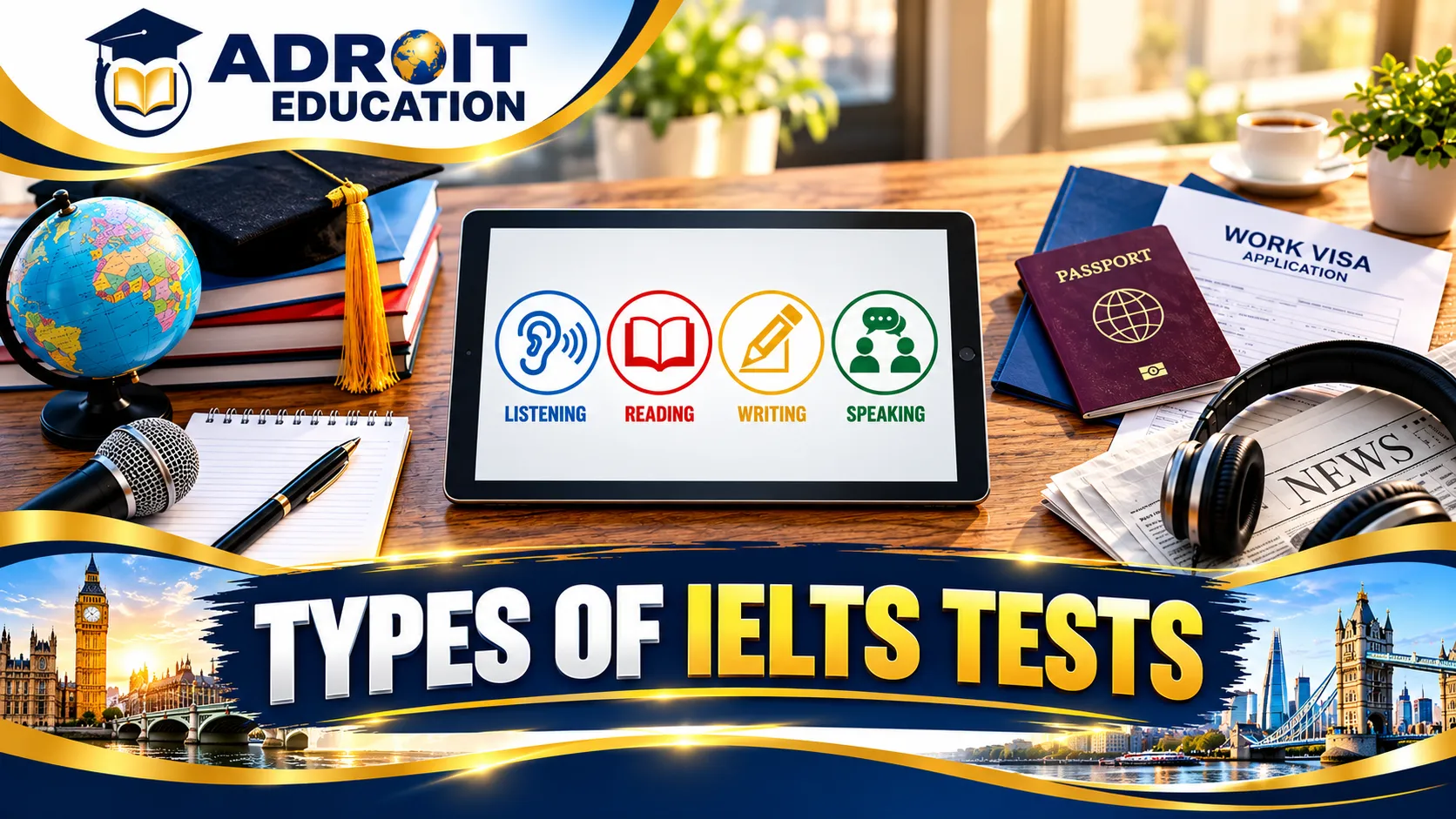
Types of IELTS Tests: Academic, General Training and Test Guide
The International English Language Testing System (IELTS) is an English proficiency test used by many universities, employers, and organizations around the world. It assesses how effectively candidates understand and communicate in English.
Choosing the right IELTS test is an important step when planning to study, work, or pursue migration opportunities abroad. The two main IELTS test types are Academic and General Training. Certain UK visa applications may also require an approved IELTS for UKVI test or IELTS Life Skills, depending on the specific route.
This guide explains the main IELTS test types, the four language skills, the test structure, and key points to consider before booking.
What Are the Main Types of IELTS Tests?
IELTS offers different test options for different purposes. Although Academic and General Training assess the same four core language skills, their Reading and Writing tasks differ.
IELTS Academic
Generally intended for people applying to higher education programs or certain professional registration pathways where an Academic English test is required.
IELTS General Training
Generally intended for people who need English skills for everyday contexts, certain work-related purposes, or eligible migration pathways.
IELTS for UKVI
An IELTS test option for certain UK visa and immigration applications. The required test format depends on the specific route and official requirements.
IELTS Life Skills
A speaking-and-listening test used for certain UK immigration purposes where this particular test is accepted and required.
IELTS Academic Test
IELTS Academic is designed for candidates who need to demonstrate English proficiency for higher education or certain professional registration purposes. Its Reading and Writing sections use tasks intended to assess skills relevant to academic study.
The test assesses four skills:
- Listening
- Reading
- Writing
- Speaking
Each skill receives a band score, and the overall band score is calculated from the four section scores. The score required depends on the institution, program, or organization receiving the result.
IELTS Listening
The Listening section assesses a candidate's ability to understand spoken English in different contexts. Recordings can include everyday conversations, social situations, and educational or academic discussions.
Test Structure
| Feature | Details |
|---|---|
| Parts | 4 |
| Questions | 40 |
| Duration | Approximately 30 minutes, with additional answer-transfer time in the paper-based format |
What Does Listening Assess?
- Understanding main ideas and key points.
- Identifying specific details and information.
- Recognizing speakers' opinions and attitudes.
- Following conversations and talks.
- Understanding the purpose and context of spoken information.
Listening preparation should include practice with different English accents, question formats, spelling, and careful time management.
IELTS Academic Reading
The Academic Reading section assesses how well candidates understand written English in academic-style texts. Texts may come from books, journals, magazines, newspapers, and other published sources.
Reading passages may present explanations, descriptions, arguments, or different viewpoints. Some materials may include diagrams, charts, or other visual information.
Test Structure
| Feature | Details |
|---|---|
| Sections | 3 passages or sections |
| Questions | 40 |
| Duration | 60 minutes |
Key Skills Assessed
- Skimming for the main idea.
- Scanning for specific information.
- Understanding the meaning of a passage.
- Recognizing arguments, opinions, and claims.
- Interpreting information presented in text and visuals.
Effective preparation involves practising a variety of question types, developing vocabulary, and learning to manage the 60-minute time limit.
IELTS Academic Writing
The Academic Writing section evaluates how clearly and accurately candidates communicate in written English. It contains two tasks, and candidates should manage their time carefully to complete both.
Writing Task 1
Candidates describe, summarize, or explain visual information such as a graph, chart, table, process, or diagram. A minimum of 150 words is required.
Writing Task 2
Candidates write an essay in response to a question, issue, or point of view. A minimum of 250 words is required. Task 2 carries greater weight in the Writing score.
Test Structure
| Feature | Details |
|---|---|
| Tasks | 2 |
| Duration | 60 minutes |
| Task weighting | Task 2 carries greater weight than Task 1 |
Writing Assessment Criteria
- Task achievement or response: How fully and appropriately the task is addressed.
- Coherence and cohesion: How clearly ideas are organized and connected.
- Lexical resource: The range and accuracy of vocabulary.
- Grammatical range and accuracy: The variety and correctness of sentence structures.
Practise planning, organizing paragraphs, supporting ideas, and checking grammar. For Academic Task 1, focus on selecting and accurately describing the most important features of the visual information.
IELTS Speaking
The Speaking test is an interview with an examiner and is designed to assess spoken communication. Candidates answer questions, speak about a given topic, and discuss ideas in more depth.
Part 1: Introduction and Interview
The examiner asks questions about familiar subjects such as home, family, studies, work, and hobbies.
Part 2: Individual Long Turn
The candidate receives a topic, has one minute to prepare, and then speaks for up to two minutes.
Part 3: Discussion
The examiner asks broader questions connected to the Part 2 topic. Candidates develop explanations and discuss ideas.
Assessment Criteria
Fluency and coherence, lexical resource, grammatical range and accuracy, and pronunciation.
The Speaking test usually lasts approximately 11–14 minutes. Regular practice, clear organization, and natural communication can help candidates prepare.
IELTS General Training
IELTS General Training is used for certain work, everyday English, and migration-related purposes. Candidates should confirm that this version is accepted by the organization or authority to which they are applying.
General Training assesses the same four core skills as Academic IELTS, but its Reading and Writing sections focus on different types of material and tasks.
- Listening: Assesses understanding of spoken English in a range of contexts.
- Reading: Includes texts commonly associated with everyday, workplace, and general-interest situations.
- Writing: Task 1 requires a letter; Task 2 requires an essay in response to a topic.
- Speaking: Uses the same three-part interview structure as Academic IELTS.
IELTS Academic vs General Training
| Feature | Academic | General Training |
|---|---|---|
| Common purpose | Higher education and certain professional registration pathways | Everyday English, certain work purposes, and eligible migration pathways |
| Listening | Same test format | Same test format |
| Reading | Academic-style texts | Everyday and work-related texts |
| Writing Task 1 | Describe or summarize visual information | Write a letter |
| Writing Task 2 | Essay | Essay |
| Speaking | Same three-part interview | Same three-part interview |
IELTS for UKVI and IELTS Life Skills
Some UK visa and immigration routes have specific English language test requirements. IELTS for UKVI is an approved test option for certain routes, while IELTS Life Skills focuses on speaking and listening at specified levels.
The test required depends on the application category and current UK government rules. A test that is suitable for one visa route may not satisfy another route's requirements.
- Identify the exact visa or immigration category.
- Check the official English language evidence requirements.
- Confirm the required test type and level before booking.
- Use an approved test provider and follow the current registration instructions.
IELTS Fees in Pakistan
IELTS test fees can vary by test type, delivery format, location, and date. Prices can also change, so candidates should confirm the latest fee with the official test provider before making a booking.
When checking the cost, confirm which test you need, whether it is Academic, General Training, or an approved UKVI option, and whether any additional services are included in the quoted price.
IELTS Band Scores and Results
IELTS reports scores on a band scale from 0 to 9. Candidates receive scores for individual skills and an overall band score. The score needed depends on the requirements of the receiving institution or organization.
A score that meets one university's requirements may not be sufficient for another program or immigration pathway. Always check the official score requirements for your specific purpose.
Frequently Asked Questions About IELTS
IELTS stands for the International English Language Testing System.
The two main test types are IELTS Academic and IELTS General Training. IELTS for UKVI and IELTS Life Skills are additional test options associated with certain UK visa requirements.
Academic is commonly used for higher education and certain professional registration pathways. General Training is used for certain work, everyday English, and migration purposes. Their Reading and Writing sections differ.
The standard IELTS Academic and General Training tests assess Listening, Reading, Writing, and Speaking.
The Listening, Reading, and Writing components take approximately 2 hours and 40 minutes in total, with no break between them. Speaking usually takes around 11–14 minutes and may be scheduled separately.
A suitable score depends on your goal. Universities, employers, professional bodies, and immigration authorities set their own requirements, so check the score needed for your application.
IELTS results are commonly treated as valid for two years, but acceptance and validity policies may differ between organizations. Confirm the policy of the institution or authority receiving your result.
The difficulty depends on your current English proficiency, the band score you need, and your preparation. A structured study plan and regular practice can help you improve.
Neither test is universally easier. The better choice depends on your strengths, the test format you prefer, and whether the receiving institution or authority accepts that test.
Difficulty is subjective and depends on your language skills and familiarity with each test format. Check which examinations are accepted for your intended purpose before choosing.
IELTS for UKVI is an IELTS test option used to meet English language requirements for certain UK visa and immigration applications. Applicants should verify the exact test required for their route.
How to Choose the Right IELTS Test
Choosing the appropriate test helps you prepare for the correct assessment and avoid booking a version that does not meet your requirements.
- Understand your study, work, professional registration, or immigration goal.
- Check which IELTS version is accepted.
- Confirm the required band score or proficiency level.
- Choose a preparation plan that covers the relevant test sections.
- Check current registration details and fees with an official test provider.
Prepare for Your IELTS Goals
Build your English skills with consistent practice, a clear preparation plan, and guidance suited to the IELTS test you need.
Conclusion
IELTS is an internationally used English proficiency test for academic, professional, and other purposes. Understanding the differences between Academic, General Training, and UKVI-related test options helps candidates make a more informed decision.
Before registering, check the exact test type, score, and evidence requirements that apply to your plans. With consistent preparation and a clear understanding of the test format, you can work towards your English language goals more confidently.